Protect your property. Call 714-475-0925 today!
Peeling paint in an older home can be more than a cosmetic problem. If the paint contains lead, peeling, chipping, cracking, sanding, scraping, or other disturbance can create lead chips and dust that may expose people in the home.
For homes built before 1978, lead-based paint is common enough that homeowners should take peeling or deteriorating paint seriously until the affected surfaces have been evaluated. EPA explains that deteriorating lead-based paint can become a hazard, particularly when paint creates chips or dust.
At The Hazmat Team, we understand that lead abatement procedures are designed to control or eliminate lead hazards while protecting occupants, workers, and the surrounding property. The appropriate procedure depends on the condition of the paint, the location and amount of affected material, the age and use of the property, and applicable regulations.
For homeowners across Orange County, California, professional work can also involve state requirements governing lead-related construction activities. California’s lead-related construction program covers work intended to reduce or eliminate lead hazards in residential and public buildings.
Key Takeaways
- Peeling lead paint should not be treated like ordinary peeling paint. Disturbing deteriorated lead paint can generate lead-containing dust and chips.
- Testing or professional evaluation matters. A visual inspection alone cannot reliably determine whether paint contains lead or whether a particular condition represents a lead hazard. Lead paint inspections and risk assessments are typically performed by independent, certified lead inspectors or environmental consultants.
- Containment is a critical part of lead-safe work. The objective is to keep dust and debris from spreading beyond the work area.
- Dry sanding, uncontrolled scraping, and other dust-generating practices can increase exposure. Lead-safe procedures are designed to minimize dust generation and contamination.
- California has its own lead-related construction requirements. Homeowners should make sure the professionals they hire are appropriately trained and certified for the work being performed.
- The right solution is not always complete removal. Depending on the circumstances, lead hazards may be addressed through removal, encapsulation, enclosure, or other appropriate controls.
What Should You Do If Paint Is Peeling in an Older Home?
If peeling paint is present in a home built before 1978, avoid treating the affected area as a routine painting project.
Do not start by sanding, aggressively scraping, power-tooling, or otherwise disturbing the surface. Those activities can release lead dust or paint chips if lead-based paint is present. EPA specifically identifies renovation activities that disturb lead paint as a potential source of hazardous lead dust.
Instead:
- Keep children and other occupants away from the affected area.
- Avoid disturbing the deteriorated paint unnecessarily.
- Do not dry sweep visible paint dust or debris.
- Determine whether lead-based paint may be present.
- Have the condition evaluated before deciding how to proceed.
- Use a lead-safe remediation professional for work that disturbs lead-based paint.
The goal is to prevent a small deteriorating-paint problem from becoming a larger dust-contamination problem.
Protect your property. Call 714-475-0925 today!
SHow Do Lead Abatement Procedures Work?
There is no single procedure that applies to every home. Professional lead abatement begins with evaluating the property and determining what type of lead hazard exists.
A typical project may involve several stages.
1. Evaluate the Property and Affected Paint
The first step is understanding what is actually present.
A lead paint inspection can identify where lead-based paint exists. A risk assessment goes further by evaluating whether lead hazards are present and what actions may be appropriate to address them. CDC distinguishes between these two types of evaluations because knowing that lead exists is not necessarily the same as determining that it is creating a hazard. These inspections and risk assessments are generally performed by independent, certified lead inspectors, risk assessors, or environmental consultants rather than by the remediation contractor performing the abatement work.
The property’s age, condition, previous renovations, location of deteriorating paint, and planned work can all affect the evaluation.
For an older home in Anaheim, Santa Ana, or elsewhere in Orange County, for example, an inspector may need to consider painted walls, windows, doors, trim, exterior surfaces, and other areas where friction or deterioration could generate dust.
2. Develop a Lead-Safe Work Plan
Once the affected areas are understood, the work needs to be planned around occupant protection and dust control.
The plan may address:
- Which surfaces will be disturbed
- How the work area will be isolated
- How occupants will be protected
- How dust and debris will be controlled
- What tools and work methods will be used
- How contaminated materials will be handled
- How the area will be cleaned
- Whether independent testing or clearance procedures are appropriate
The complexity of the plan depends on the project. A small deteriorated surface is different from extensive peeling paint throughout several rooms.
3. Establish Containment
Containment is one of the most important parts of lead-safe work.
The purpose is straightforward: keep lead-containing dust and debris inside the controlled work area instead of allowing them to migrate through the home.
EPA’s lead-safe renovation requirements include work-area containment to prevent dust and debris from leaving the work area.
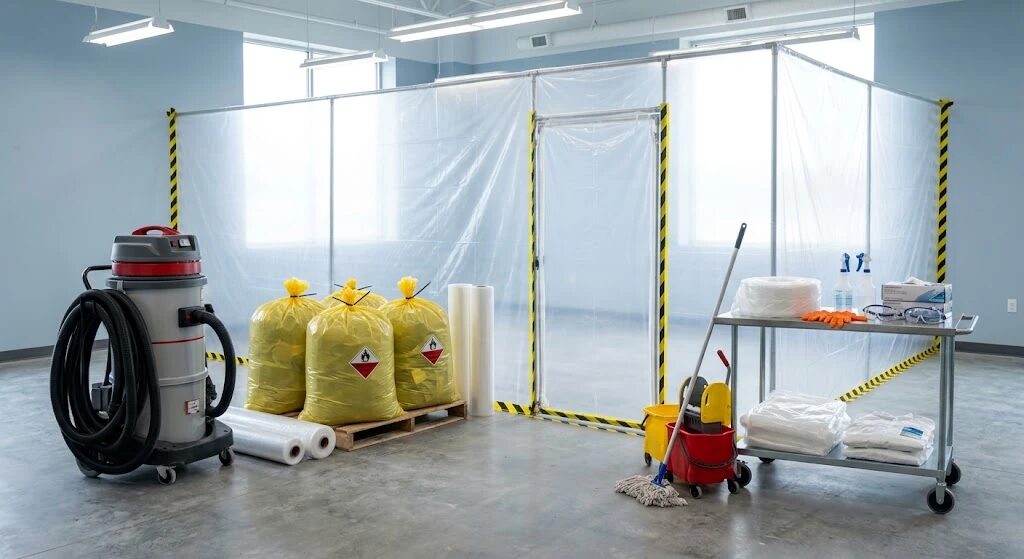
Professional containment may involve barriers, protective coverings, controlled access, and other measures appropriate to the project.
THE HAZMAT TEAM describes using plastic sheeting, tarps, protected walkways, controlled work areas, and air-filtration measures as part of its broader abatement approach.
4. Use Lead-Safe Removal or Abatement Methods
The appropriate treatment depends on the surface and the project.
Possible approaches can include:
- Controlled removal of deteriorated material
- Encapsulation
- Enclosure
- Component replacement
- Specialized cleaning
- Other approved methods for reducing or eliminating the hazard
The important distinction is that lead abatement is not simply ordinary paint removal.
Aggressive sanding or uncontrolled scraping can turn deteriorated paint into airborne dust. EPA’s lead-safe renovation requirements specifically restrict certain dust-generating practices and require controls designed to minimize lead contamination.
5. Control Lead Dust During the Work
Lead dust control is central to the project.
Work practices are selected to minimize the amount of dust generated and prevent contaminated material from spreading.
Depending on the project, controls may include:
- Containment barriers
- Protective sheeting
- Controlled access
- Appropriate dust-suppression techniques
- HEPA-filtered equipment where appropriate
- Careful handling of debris
- Proper work-area cleaning
EPA recommends lead-safe work practices specifically because renovation and repair activities can generate dangerous lead dust.
6. Remove and Handle Waste Properly
Peeling paint, contaminated debris, protective materials, and other project waste need to be handled carefully.
Waste should not simply be swept into an ordinary household pile or spread throughout the property.
The exact requirements can depend on the material, project, and applicable regulations. A professional abatement contractor should understand the requirements that apply to the project and manage contaminated waste accordingly.
THE HAZMAT TEAM states that its abatement process includes carefully packaging project waste and taking it to appropriate landfill sites.
7. Thoroughly Clean the Work Area
Cleaning is not an optional finishing step.
After lead-related work, the area must be cleaned carefully to remove dust and debris generated during the project. EPA’s lead-safe work requirements include thorough cleanup followed by verification procedures intended to minimize exposure to lead-based paint hazards.
Depending on the project, cleaning may involve HEPA vacuuming and wet cleaning methods.
EPA also recommends HEPA vacuuming and wet cleaning when addressing visible dust or debris from deteriorating lead paint and cautions against dry sweeping.
8. Independent Verification of Completed Work
Depending on the scope of the project, post-work verification or clearance testing may be appropriate.
This is an important distinction: finishing the physical removal work does not automatically mean the property has been properly cleaned.
Clearance testing and verification are typically performed by an independent, third-party certified lead inspector or laboratory — not by the remediation contractor who performed the abatement work. This separation helps confirm that the work area meets applicable clearance criteria.
Testing and verification requirements can depend on the type of work, applicable regulations, and project specifications. For larger or more complicated projects, this independent evaluation can provide an additional level of confidence before occupants return to the space.
Why Is Peeling Lead Paint a Concern?
Lead-based paint is not necessarily an immediate hazard simply because it exists in an older home.
The condition of the paint matters.
EPA notes that homes can contain lead-based paint while occupied safely when painted surfaces are maintained and kept in good condition. The concern increases when paint deteriorates, peels, chips, cracks, or creates dust.
Friction is another important factor.
Windows, doors, stairways, floors, and other surfaces that rub against one another or experience repeated wear can generate lead-containing dust if lead-based paint is present. CDC specifically identifies areas such as windows, doors, floors, porches, stairways, and cabinets as common locations where lead dust can occur.
That means a small-looking paint problem around a frequently used window can deserve more attention than a larger area of intact paint that is rarely disturbed.
Is It Safe to Paint Over Peeling Lead Paint?
Simply painting over peeling paint is not a universal solution.
If the underlying paint is deteriorating, the surface generally needs to be appropriately stabilized before a new coating can provide a durable solution. Painting over loose, flaking material without addressing the underlying condition can leave the hazard unresolved.
The appropriate treatment depends on:
- Whether lead is actually present
- The condition of the existing coating
- The substrate underneath the paint
- The location of the damaged surface
- How much of the surface is affected
- Whether the surface experiences friction or impact
- Future renovation plans
- Applicable lead regulations
A professional evaluation can help determine whether removal, encapsulation, enclosure, repair, or another approach is appropriate.
Can You Remove Peeling Lead Paint Yourself?
Homeowners should be cautious about DIY work involving suspected lead paint.
EPA recommends that homeowners hire lead-safe certified contractors for renovation, repair, and painting projects involving pre-1978 homes.
The federal RRP requirements generally apply to contractors performing covered renovation work for compensation. There are exceptions and different requirements depending on who owns or occupies the property and what type of work is being performed.
Even when a particular DIY project is not subject to the federal RRP rule, that does not mean the work is risk-free.
Lead dust can be difficult to see. A homeowner can unintentionally spread contamination through clothing, shoes, tools, cleaning equipment, or household surfaces.
For that reason, homeowners should think beyond the question of whether they are legally allowed to perform a task and consider whether they can actually control the lead hazard safely.
What Lead Abatement Requirements Apply in California?
California has additional requirements for lead-related construction work.
Cal/OSHA’s construction lead standard applies to construction activities where employees may be occupationally exposed to lead. The standard covers activities including removal or encapsulation of lead-containing materials, renovation, repair, painting, demolition, cleanup, and related handling or containment activities.
California’s Department of Public Health also operates a Lead-Related Construction program. CDPH states that individuals performing work designed to reduce or eliminate lead hazards in California residential or public buildings are required to hold the applicable certification, including Lead Supervisor or Worker certification for the relevant work.
California updated its occupational lead standards effective January 1, 2025, so contractors and employers should rely on current California requirements rather than older guidance.
For homeowners, the practical takeaway is simple: ask who will perform the work, what certifications apply, and how the contractor will control lead dust and protect occupants.
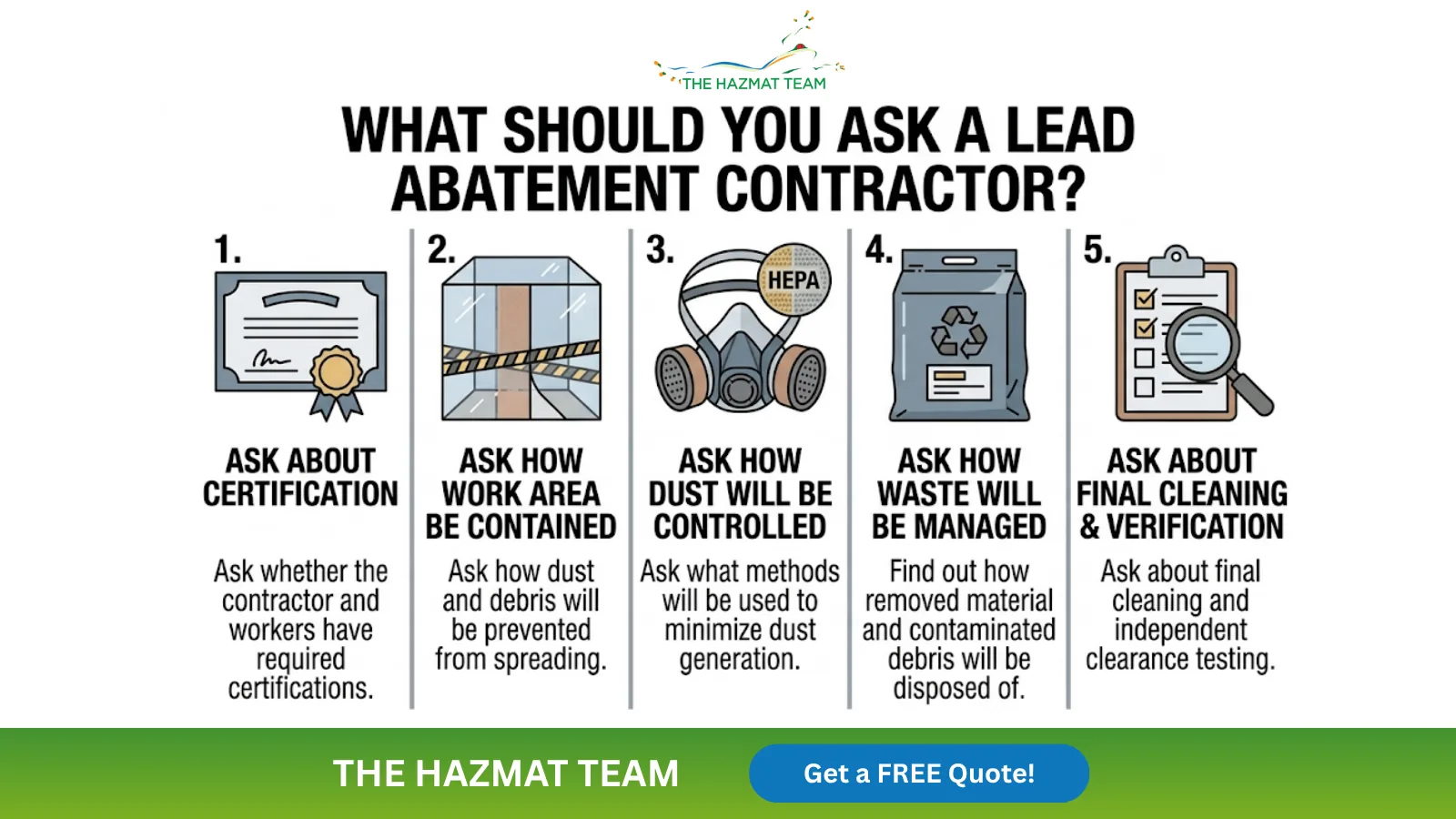
What Should You Ask a Lead Abatement Contractor?
Before hiring a contractor, homeowners should be comfortable asking specific questions.
Ask About Certification
Ask whether the contractor and workers performing the applicable lead-related work have the certifications required for the project.
California maintains an index of certified lead professionals that homeowners can use when evaluating qualifications.
Ask How the Work Area Will Be Contained
A good contractor should be able to explain how dust and debris will be prevented from spreading to other areas of the home.
If the answer is simply “we’ll be careful,” ask for more detail.
Ask How Dust Will Be Controlled
Ask what methods will be used to minimize dust generation and how the work area will be cleaned afterward.
EPA’s lead-safe practices emphasize containment, dust minimization, and thorough cleanup.
Ask How Waste Will Be Managed
Find out how removed material and contaminated debris will be packaged, transported, and disposed of.
Ask About Final Cleaning and Independent Verification
Ask what happens after the physical work is finished.
Depending on the project, there may be specific cleaning requirements to satisfy before occupants return, along with independent clearance testing performed by a third-party certified inspector or laboratory rather than the remediation contractor itself.
Protect your property. Call 714-475-0925 today!
Lead Abatement Procedures vs. Ordinary Paint Removal
The difference is important.
Ordinary paint removal focuses primarily on removing or preparing a coating.
Lead abatement focuses on controlling a lead hazard while protecting occupants, workers, and the surrounding environment.
That changes how the project is planned.
A lead-related project has to consider dust generation, containment, worker protection, occupant exposure, waste handling, cleaning, and applicable regulations—not simply how quickly the old paint can be removed.
This is why homeowners should be cautious about hiring a general painter for a project involving known or suspected lead-based paint.
What About Small Areas of Peeling Paint?
A small area should not automatically be treated as an emergency, but it should not automatically be treated as harmless either.
EPA recommends maintaining painted surfaces and addressing small areas of damaged paint without sanding. EPA’s current home guidance specifically recommends wet cleaning of peeling or chipping paint and advises that small damaged areas be repaired without sanding.
The appropriate response depends on whether lead is present, the location of the damaged area, the condition of the surrounding paint, and whether the area will be disturbed during planned repairs.
If the home is older and the paint has not been evaluated, an evaluation by a certified lead inspector is a sensible first step.
Why Professional Containment Matters
Lead contamination does not necessarily remain where the paint originally peeled.
Dust can travel through foot traffic, clothing, tools, airflow, and inadequate cleaning.
That is why containment is more than putting a sheet of plastic over a floor.
The work area should be planned so that occupants are separated from the activity and contaminated debris is controlled throughout the project. EPA’s lead-safe renovation requirements specifically emphasize preventing dust and debris from leaving the work area.
For homeowners, this is one of the most useful questions to ask before work begins:
“How are you going to keep lead dust from spreading into the rest of my home?”
A qualified contractor should have a clear answer.
Lead Abatement in Orange County, California
For homeowners across Orange County — including Anaheim, Garden Grove, Westminster, Fullerton, Santa Ana, Orange, Huntington Beach, Costa Mesa, and surrounding communities — selecting a contractor with experience in hazardous-material abatement can simplify an otherwise complicated project.
THE HAZMAT TEAM provides lead removal services along with asbestos abatement, biohazard remediation, and mold remediation. The company’s stated approach emphasizes containment, occupant protection, careful waste handling, and regulatory compliance.
THE HAZMAT TEAM serves Orange County and the surrounding Southern California region and lists its contact number as 714-475-0925. Its website also identifies its service location in Garden Grove while serving Anaheim, Westminster, Fullerton, and other nearby Orange County communities.
For homeowners dealing with peeling paint, the first conversation should focus on the condition of the property and the appropriate next step—not on unnecessary fear or pressure.
When Should You Call a Professional?
Consider professional help when:
- Peeling or deteriorating paint is present in a pre-1978 home.
- Paint is deteriorating around windows, doors, stairs, or other high-friction surfaces.
- You see paint chips or visible dust.
- You are planning remodeling work that will disturb painted surfaces.
- Multiple rooms contain deteriorating paint.
- Children or other occupants may have access to the affected area.
- You are unsure whether the paint contains lead.
- Previous renovation work may have disturbed lead-based paint.
- You need to remove or encapsulate lead-containing materials.
- You want the work completed using appropriate lead-safe procedures.
The need for professional intervention depends on the circumstances, but the cost of an evaluation can be small compared with the complications created by uncontrolled lead dust.
The Bottom Line
Peeling paint in an older home deserves attention, but homeowners do not need to panic.
The important question is whether the paint contains lead and, if it does, whether the deteriorated or disturbed material is creating a lead hazard.
The right lead abatement procedures focus on controlling that hazard from start to finish: evaluate the affected surfaces, plan the work, contain the area, minimize dust, use appropriate removal or stabilization methods, manage waste carefully, clean thoroughly, and complete any required independent verification.
For homeowners across Orange County, choosing professionals who understand both lead-safe work practices and applicable state requirements is especially important.
If you are dealing with peeling or deteriorating paint in Anaheim, Garden Grove, Westminster, Fullerton, or elsewhere in Orange County, THE HAZMAT TEAM offers lead removal services and can be contacted at 714-475-0925 to discuss the property and next steps.
Frequently Asked Questions
Q: What are lead abatement procedures?
A: Lead abatement procedures are controlled methods used to reduce or eliminate lead hazards in a property. Depending on the project, they can involve evaluation, containment, removal, encapsulation, enclosure, specialized cleaning, waste handling, and independent post-work verification.
Q: How do you safely remove peeling lead paint?
A: The safest method depends on the property and the condition of the paint. Lead-safe work generally emphasizes containment, minimizing dust generation, appropriate removal or stabilization methods, careful waste handling, and thorough cleanup. EPA recommends using lead-safe certified contractors for renovation work that disturbs lead-based paint in pre-1978 homes.
Q: Should I sand peeling lead paint?
A: Do not assume that sanding is safe simply because the damaged area is small. Sanding can create lead dust. EPA recommends repairing small damaged areas without sanding and using lead-safe practices when work involving lead-based paint is necessary.
Q: How can I tell if peeling paint contains lead?
A: You generally cannot determine lead content reliably just by looking at the paint. A lead paint inspection can identify lead-based paint, while a risk assessment evaluates lead hazards and appropriate corrective actions. These evaluations are performed by independent, certified lead inspectors or risk assessors.
Q: Is lead paint dangerous if it is not peeling?
A: Lead-based paint that is intact and properly maintained does not necessarily create the same exposure risk as deteriorating paint. However, friction, renovation, repairs, or other disturbance can create lead dust.
Q: Do Orange County homes require special lead procedures?
A: California has specific requirements for lead-related construction work, including occupational protections and certification requirements for certain lead-related construction activities in residential and public buildings. The requirements depend on the work being performed and the circumstances of the project, and they apply to homes throughout Orange County, including Anaheim, Garden Grove, Westminster, Fullerton, Santa Ana, and surrounding cities.
Q: Can I stay in my home during lead abatement?
A: Whether occupants can remain depends on the scope and setup of the project. Because lead-safe work is designed to prevent occupant exposure, residents should follow the contractor’s instructions about restricted areas, access, and temporary relocation when applicable. EPA recommends keeping residents out of work areas during renovation or repair work that disturbs painted surfaces in older homes until the work is completed and the area has been cleaned.
Services We Offer
- Asbestos Abatement Services
- Biohazard Remediation Services
- Lead Removal Services
- Mold Remediation Services