Finding mold is only the beginning of understanding the problem.
A dark patch on drywall, a musty smell near a cabinet, or staining after a plumbing leak may show where moisture has affected a building. But the visible area does not always reveal where the water came from, how far it traveled, or which materials need attention.
That is why a proper mold inspection in Orange County should focus on the conditions behind the growth before remediation begins.
The EPA identifies moisture control as the key to controlling mold. If mold is cleaned without correcting the water problem, it is likely to return.
At The Hazmat Team, we provide professional mold remediation services for residential, commercial, and multi-unit properties throughout Greater Orange County and surrounding Southern California communities. Before remediation starts, understanding the source and extent of the problem helps create a more appropriate cleanup plan.
Protect your property. Call 714-475-0925 today!
Key Takeaways
- Find and correct the moisture source before treating mold as a surface-cleaning problem.
- Check beyond visible growth because water can spread behind walls, beneath floors, and into cabinets or ceilings.
- Look at both porous and nonporous materials because they respond differently to prolonged moisture.
- Routine air testing is not always necessary to determine whether mold remediation is needed.
- The size, location, water source, and affected materials help determine whether professional remediation is appropriate.
- Remediation should not be considered complete if moisture problems, visible mold, or moldy odors remain.
What Should Be Checked Before Mold Remediation Begins?
Before remediation begins, the property should be evaluated for the water source, visible mold, hidden moisture, affected materials, the size of the damaged area, and conditions that could spread contamination during cleanup.
The goal is not simply to identify mold.
The goal is to understand why it developed and what needs to be addressed so it does not immediately return.
A useful pre-remediation assessment usually begins with several questions:
- Where did the moisture originate?
- Is the leak or water source still active?
- How long were materials wet?
- Which rooms or building components were affected?
- Is mold visible?
- Are musty odors present?
- Could water have entered concealed spaces?
- Are porous materials damaged?
- Is the HVAC system involved?
- How large is the affected area?
These answers help define the remediation scope.
1. Find the Moisture Source First
The first thing to investigate is why the area became wet.
Mold requires moisture to grow. Removing visible mold without correcting the source leaves the underlying problem in place.
Possible sources include:
- Plumbing leaks
- Roof leaks
- Window intrusion
- Appliance failures
- HVAC condensate problems
- Overflowing fixtures
- Poor drainage
- Flooding
- Persistent condensation
- High indoor humidity
The EPA advises property owners to repair plumbing leaks and other water problems promptly and dry affected materials completely.
If an active leak remains, remediation may only provide temporary results.
Protect your property. Call 714-475-0925 today!
2. Determine How Far the Water Traveled
Visible water damage does not always show the full extent of moisture migration.
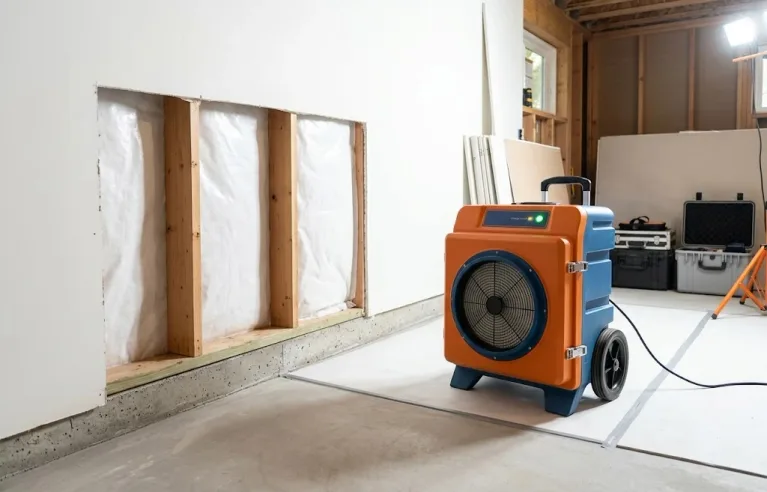
For example, a leaking pipe inside a kitchen wall can affect drywall, insulation, cabinetry, flooring, and the subfloor before water becomes visible.
Water may also travel horizontally or vertically through building materials.
Areas worth checking can include:
- Behind baseboards
- Beneath flooring
- Inside cabinets
- Behind drywall
- Around plumbing penetrations
- Inside ceiling cavities
- Below windows
- Around roof penetrations
- Adjacent rooms
- Lower floors beneath the original leak
This is why a small stain should not automatically be treated as proof of a small moisture problem.
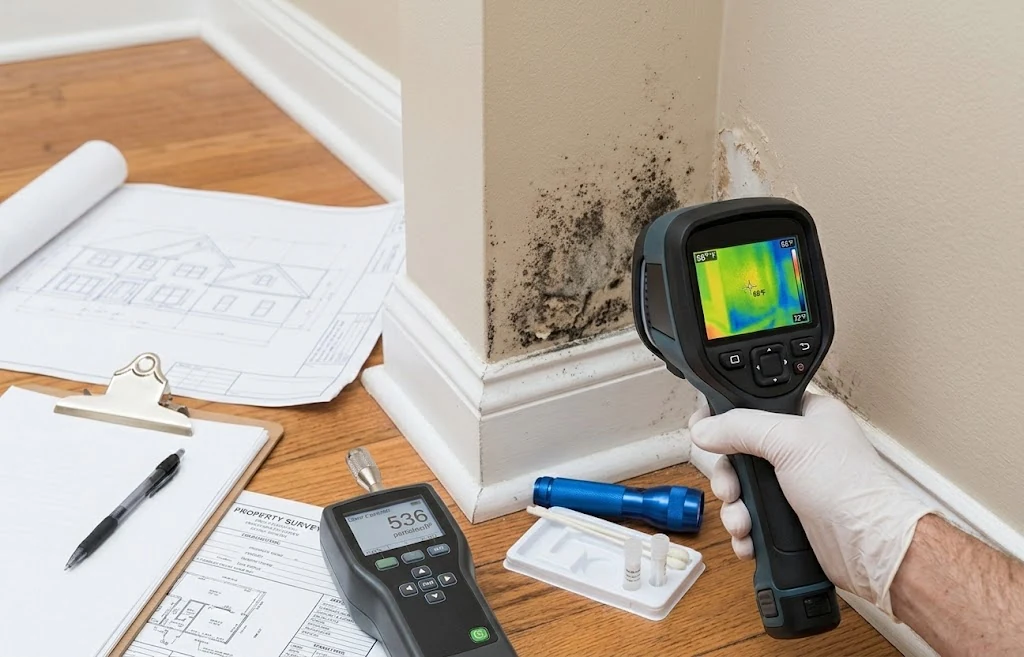
3. Look for Visible Mold and Water Damage
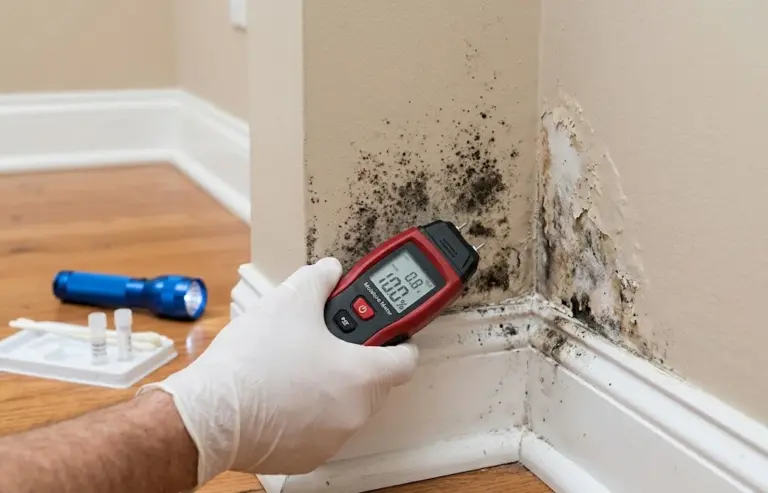
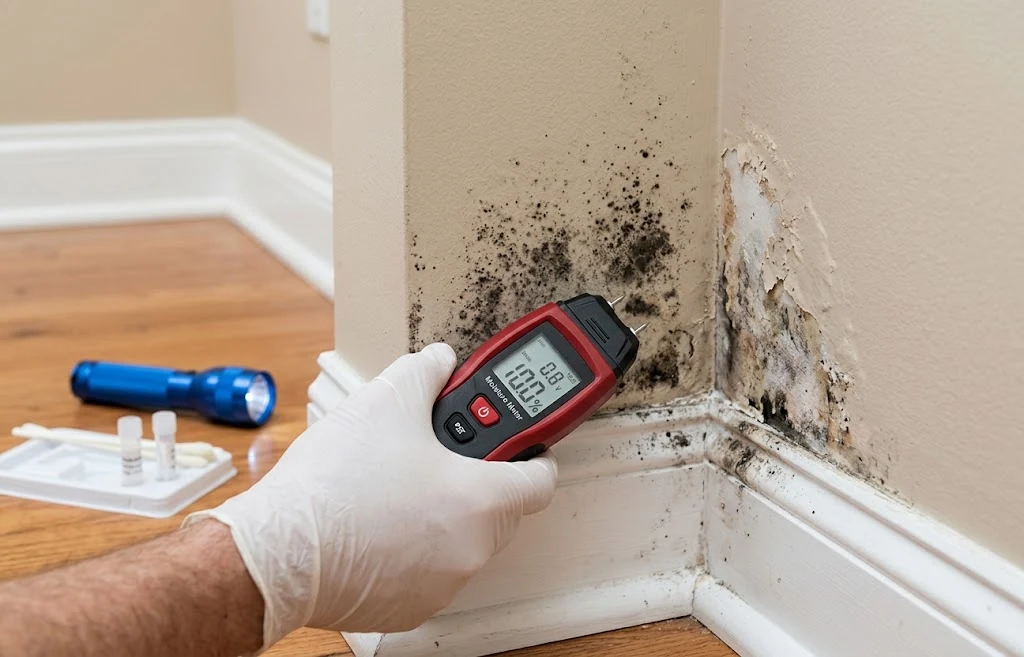
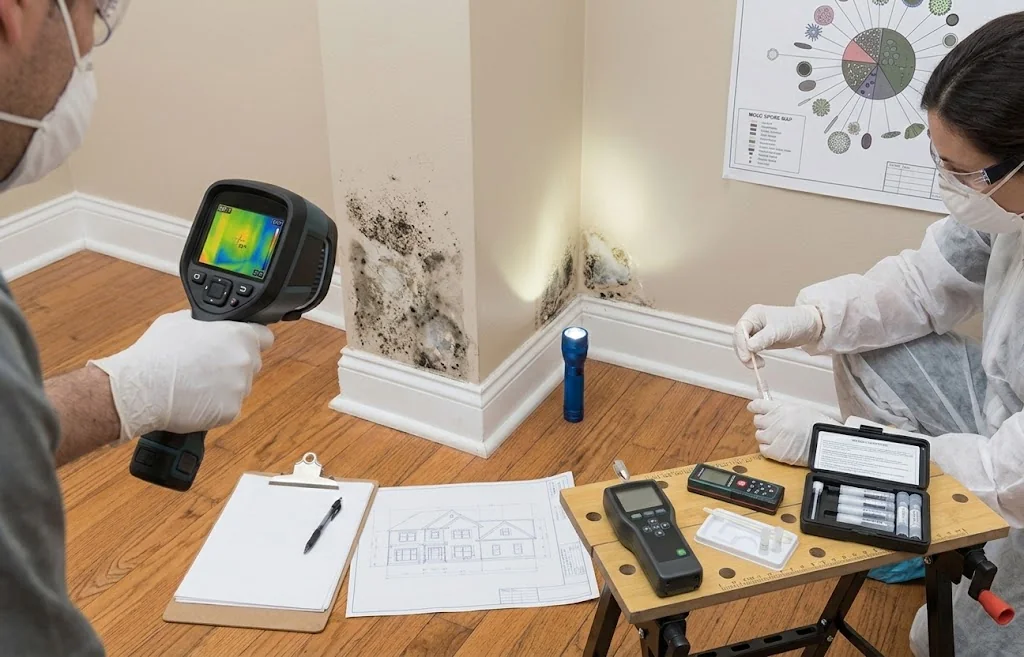
A thorough visual inspection remains one of the most useful parts of evaluating a mold problem.
CDC/NIOSH notes that visual inspection and identifying musty odors can be more reliable for finding dampness problems than short-duration air sampling.
Look for:
- Visible mold growth
- Water stains
- Peeling paint
- Bubbling finishes
- Soft drywall
- Swollen baseboards
- Warped flooring
- Discolored grout or caulk
- Damaged ceiling materials
- Damp insulation
- Surface condensation
Visible mold may appear black, green, white, gray, brown, or another color. Color alone does not tell you how hazardous the mold is or how extensive the underlying moisture problem may be.
4. Pay Attention to Musty Odors
A persistent musty smell can indicate hidden dampness or microbial growth even when the affected material cannot be seen directly.
Odor can be particularly useful around:
- Cabinets
- Closets
- Wall cavities
- Bathrooms
- Laundry rooms
- HVAC areas
- Carpeted rooms
- Spaces beneath sinks
If the smell becomes stronger in a particular location, that area may deserve closer investigation.
However, odor alone cannot tell you the exact size or type of mold problem. It is a clue—not a complete diagnosis.
5. Check Porous Materials Carefully
Porous materials deserve special attention because moisture and mold can penetrate below the surface.
Examples include:
- Drywall
- Ceiling tile
- Carpet
- Carpet padding
- Insulation
- Upholstery
- Certain wood products
- Paper products
The EPA explains that absorbent or porous materials may need to be discarded when moldy because growth can enter spaces and crevices that are difficult or impossible to clean completely.
That does not mean every damp porous material automatically requires removal.
The decision depends on factors such as:
- Length of water exposure
- Amount of saturation
- Material condition
- Mold growth
- Water contamination
- Whether the material can be fully dried and cleaned
6. Determine How Long Materials Stayed Wet
Time matters.
EPA guidance recommends drying water-damaged areas and materials within approximately 24 to 48 hours whenever possible to help prevent mold growth.
Materials that stayed wet for several days deserve closer examination, even if the surface now appears dry.
Ask:
- When did the leak begin?
- When was it discovered?
- When was the water source stopped?
- When did drying begin?
- Did flooring or walls remain wet afterward?
- Was professional drying equipment used?
If no one knows when the water problem started, it may be safer to assume the affected area requires more careful evaluation.
7. Check Whether the HVAC System Is Involved
HVAC involvement can make mold problems more complicated.
If moisture or visible mold is present near:
- Air handlers
- Supply vents
- Return vents
- Ductwork
- Condensate pans
- HVAC closets
the system may require additional evaluation.
The EPA advises against operating an HVAC system known or suspected to be contaminated with mold because doing so may spread contamination through the building.
A mold problem near an air intake deserves particular attention before remediation begins.
8. Determine the Size of the Mold-Affected Area
The size of the affected area can influence how cleanup should be handled.
The EPA states that a moldy area smaller than about 10 square feet can often be handled by a homeowner in ordinary circumstances. Larger areas, extensive water damage, contaminated water, or HVAC involvement may warrant professional assistance.
Size is not the only factor, though.
A small visible patch may still require professional attention when:
- Mold is inside a wall cavity.
- Sewage or contaminated water was involved.
- The HVAC system is affected.
- Multiple areas are involved.
- Materials are extensively saturated.
- Occupants have health concerns.
- The moisture source remains unclear.
A better decision comes from looking at the entire situation rather than measuring only what is visible.
Understand the Mold Problem Before Starting Cleanup
Successful mold remediation starts with understanding the building.
Before materials are removed, determine where the water came from, how far it traveled, what became wet, and whether contamination may extend beyond the visible area.
That information helps prevent unnecessary demolition while also reducing the chance that hidden moisture or mold is left behind.
At The Hazmat Team, we provide professional mold remediation services throughout Orange County and surrounding Southern California communities. Our approach emphasizes safety, clear communication, and addressing the conditions that allowed the problem to develop.
If mold has been identified and your property requires professional remediation, call The Hazmat Team at 714-475-0925 to discuss the next step.
Frequently Asked Questions
Q: What should be checked during a mold inspection?
A: A mold inspection should focus on visible growth, water damage, active or previous leaks, musty odors, affected materials, hidden moisture pathways, HVAC involvement, and how far the problem may extend. The moisture source is especially important because mold can return if the water problem remains.
Q: Is air testing required before mold remediation?
A: Not necessarily. If visible mold and a moisture problem are already present, routine air testing may not be needed to determine that remediation is appropriate. CDC/NIOSH notes that visual inspection and dampness assessment can often provide more useful information than short-term air sampling.
Q: Can mold grow behind walls even if I cannot see it?
A: Yes. Mold can develop on concealed materials when water reaches wall cavities, insulation, drywall backing, cabinetry, or other hidden spaces. Past leaks, musty odors, staining, and material damage can indicate that further investigation is warranted.
Q: How quickly should water-damaged materials be dried?
A: EPA guidance recommends drying wet materials within approximately 24 to 48 hours whenever possible to reduce the likelihood of mold growth.
Q: Does black mold require a different inspection?
A: Color alone should not determine how a mold problem is evaluated. The inspection should focus on the moisture source, extent of growth, affected materials, and conditions in the building rather than assuming risk based solely on color.
Q: Should I remove drywall before a mold inspection?
A: Not necessarily. Removing drywall without first understanding the scope of contamination may release mold particles into nearby areas. When hidden mold is suspected, investigation should be planned carefully before building materials are opened.
Q: Can mold return after professional remediation?
A: Yes, if moisture returns. Even effective cleanup may only provide a temporary result if plumbing leaks, roof problems, high humidity, condensation, or other moisture sources remain unresolved.
Q: Does The Hazmat Team provide mold remediation in Orange County?
A: Yes. The Hazmat Team provides mold remediation services for residential, commercial, and multi-unit properties throughout Greater Orange County and surrounding Southern California communities, including Westminster.
Services We Offer
- Asbestos Abatement Services
- Biohazard Remediation Services
- Lead Removal Services
- Mold Remediation Services